
By: Apnom Youth Organisation | Youth Development and Public Awareness
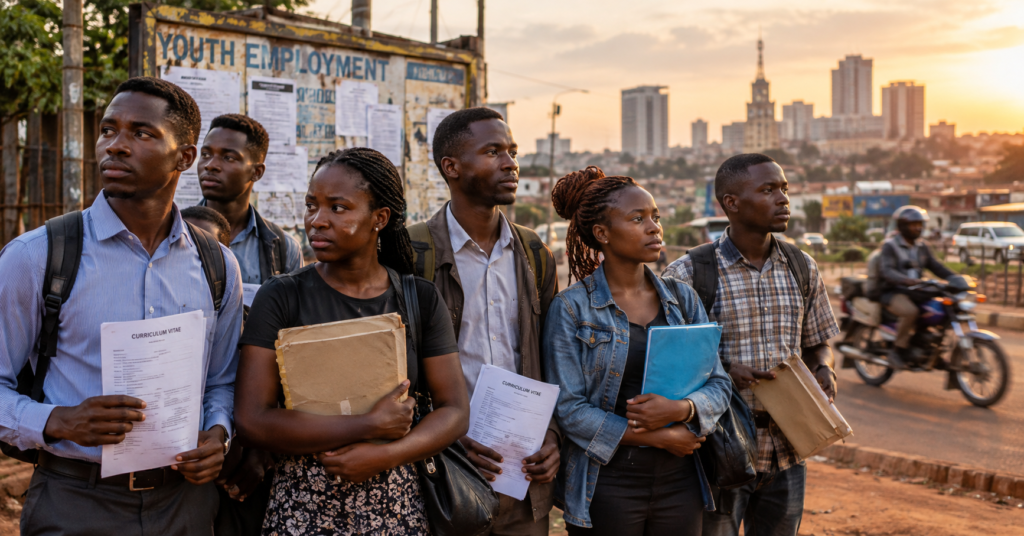
Uganda cannot afford to lose a generation of young people to unemployment, hopelessness and wasted potential. Behind every young person searching for a job is a dream delayed, a family hoping for support, a skill waiting to be used, and a future that could transform a community.
Uganda is a young nation, blessed with energetic, creative, ambitious and innovative young people. From university graduates and vocational trainees to school leavers, young farmers, artists, sportspeople and aspiring entrepreneurs, the country possesses an enormous human resource. Yet, for many young Ugandans, the transition from education to meaningful employment remains a difficult and frustrating journey.
The problem is no longer simply about finding a job. It is about finding decent work, earning a sustainable income, accessing opportunities, developing relevant skills and being able to participate meaningfully in the country’s economic growth.
Youth unemployment and underemployment must therefore be treated not merely as economic challenges, but as national development priorities that demand urgent, coordinated and practical action.
1. THE NUMBERS TELL A WORRYING STORY
According to the Uganda Bureau of Statistics (UBOS), the 2025 Labour Market Survey reported a 17.9% unemployment rate among young people aged 15–24, compared with a national unemployment rate of 12.2% among people aged 15 and above. Youth unemployment was higher among females, at 21.0%, than males, at 15.2%.
These figures reveal an important national challenge: young people are entering the labour market, but the economy is not creating enough accessible, decent and productive opportunities for everyone seeking work.
Uganda’s National Planning Authority has also identified persistent youth unemployment and underemployment as significant development challenges, highlighting the concentration of young workers in informal employment, where earnings, security and opportunities for advancement can be limited.
It is important to distinguish unemployment from underemployment and exclusion from education or training. A young person may be working yet earning too little to meet basic needs; another may be doing temporary work unrelated to their qualifications; and another may have stopped looking for a job after repeated disappointments.
All these situations deserve attention.
The real question is not only how many young people are unemployed, but how many are unable to build a productive, dignified and sustainable livelihood.
2. WHY ARE SO MANY YOUNG UGANDANS STRUGGLING TO FIND WORK?
A. An Education-to-Employment Gap
Education should open doors, but many young people complete school, university or vocational training without the practical experience employers expect.
Some courses offer limited exposure to real working environments, while opportunities for internships, apprenticeships and workplace learning remain insufficient for the number of young people seeking entry-level positions.
There is a need to strengthen the connection between education, practical competence, innovation and the world of work.
The solution is not to discourage education. Rather, Uganda must ensure that education equips young people with relevant skills, professional confidence and the ability to respond to the demands of a changing economy.
B. Too Few Opportunities for First-Time Job Seekers
Many employers require experience, yet young people cannot gain experience without someone giving them a first opportunity.
This creates a frustrating cycle: no job without experience, and no experience without a job.
Government agencies, private companies, civil society organisations and other employers need structured graduate traineeships, apprenticeships, paid internships and entry-level recruitment programmes that provide genuine learning opportunities and pathways into employment.
C. Limited Access to Capital and Business Support
Entrepreneurship is frequently presented as the answer to unemployment. However, telling a young person to start a business means little when they lack startup capital, equipment, workspace, reliable markets, business knowledge or affordable financing.
A young farmer may have land but lack irrigation and storage. A talented designer may have the skills but lack a computer and reliable internet. A trained mechanic may have the knowledge but lack tools and a workshop.
Youth enterprise programmes must therefore offer more than loans. They should combine finance with mentorship, market access, business development services and ongoing support.
D. Heavy Dependence on Informal and Low-Productivity Work
Uganda’s labour market relies heavily on informal employment. While informal businesses provide essential livelihoods, many young workers face irregular earnings, limited social protection and few opportunities to grow.
The challenge is not to eliminate small businesses. It is to help them become more productive, resilient and capable of creating decent work.
Supporting small and medium-sized enterprises, expanding local manufacturing, strengthening agricultural value chains and improving access to technology could help more businesses grow and employ others.
E. Unequal Access to Opportunities
A young person in a rural community may face different barriers from someone in Kampala. Access to reliable electricity, internet, transport, training institutions, professional networks and financial services varies considerably.
Young women can encounter additional barriers, including unequal access to resources and the burden of unpaid care work. Young people with disabilities may face inaccessible workplaces, training facilities and recruitment systems.
A national response must recognise these differences rather than assume that one programme will work equally well for everyone.
F. The Pressure of a Growing Youth Population
Every year, new school leavers, graduates and vocational trainees enter the labour market. Their ambitions are legitimate, but the availability of jobs, productive enterprises and viable self-employment opportunities does not automatically increase at the same pace.
Uganda must therefore think beyond filling existing vacancies. It must deliberately build an economy in which more productive jobs and businesses can emerge.
3. THE CONSEQUENCES: WHAT HAPPENS WHEN A GENERATION CANNOT FIND OPPORTUNITY?
Youth unemployment does not affect only the individual who lacks a job. Its consequences spread through families, communities, institutions and the entire national economy.
Poverty and Financial Dependence
Young people who cannot earn a reliable income may remain dependent on parents and guardians long after completing their education. Families that have invested their limited resources in school fees may struggle to support them indefinitely.
Mental and Emotional Distress
Repeated rejection, financial insecurity and the pressure to meet family expectations can undermine confidence, create anxiety and contribute to feelings of hopelessness. Communities must recognise that young people need emotional support alongside economic opportunities.
Wasted Talent and National Productivity
Every unemployed graduate, unutilised technician, struggling artist and aspiring entrepreneur represents potential that the economy is failing to harness fully. When skills remain unused, the country loses opportunities for innovation, productivity and economic growth.
Vulnerability to Exploitation and Harmful Activities
Economic desperation can expose some young people to deceptive recruitment schemes, financial scams, exploitative work, dangerous migration arrangements and other harmful situations.
Unemployment does not automatically lead to crime or substance misuse, but the absence of support and legitimate opportunities can increase vulnerability.
Delayed Independence and Family Formation
Without a sustainable income, many young adults struggle to afford housing, meet family responsibilities or plan their futures.
Growing Inequality and Frustration
When opportunities appear inaccessible or unfairly distributed, trust in institutions can weaken. Young people may become increasingly frustrated when they see education, hard work and talent failing to translate into meaningful progress.
These consequences should not be used to portray young people as a problem. Instead, they should remind the country that failure to invest in youth employment is a failure to fully invest in Uganda’s own development.
4. THE WAY FORWARD: WHAT MUST UGANDA DO?
Solving youth unemployment requires a coordinated national response. No single ministry, organisation or individual can address the challenge alone.
1. Government Must Prioritise Job-Rich Economic Growth
Government should place measurable employment outcomes at the centre of economic planning, public investment and development programmes.
Investment in infrastructure, manufacturing, agro-processing, tourism, renewable energy, technology and other productive sectors should be accompanied by clear plans for local employment, skills transfer and enterprise development.
Uganda’s National Development Plan IV and Human Resource Development Plan recognise employment, skills development and private-sector growth as important priorities. The task is to translate these ambitions into opportunities that young people can see and access.
Government should also publish accessible information on employment programmes, available opportunities, beneficiaries, funding, results and the number of sustainable jobs created.
2. Reform Education to Meet the Demands of the Modern Economy
Uganda must strengthen practical, competency-based education at every level.
Schools, universities and vocational institutions should work closely with employers to identify emerging skills needs and improve curricula accordingly.
Priority areas should include:
- Digital literacy, software development, artificial intelligence and other technology-related skills.
- Engineering, construction, electrical installation and other technical trades.
- Modern agriculture, food processing and agribusiness.
- Business management, financial literacy and entrepreneurship.
- Creative industries, including music, dance, design, film and digital content.
- Communication, teamwork, critical thinking and problem-solving.
Career guidance should begin before students complete school. Young people need realistic information about different career pathways, the skills employers require and the opportunities available through technical and vocational training.
3. Make Internships and Apprenticeships Accessible
Government and private-sector employers should establish structured pathways for first-time job seekers.
Every major sector should be encouraged to offer meaningful workplace learning, with clear training objectives, supervision and opportunities for recruitment.
Internships should not become a source of cheap labour. Where possible, they should be paid or supported with reasonable transport and meal allowances, especially for young people from low-income households.
A first opportunity can help a young person gain experience, build professional networks and become more competitive in the labour market.
4. Transform Agriculture into a Source of Youth Prosperity
Agriculture remains central to Uganda’s economy, but young people must see it as a viable business opportunity rather than a last resort.
Government, financial institutions and agricultural organisations should support youth-led enterprises in irrigation, mechanisation, poultry, livestock, fisheries, horticulture, food processing, packaging, storage and distribution.
Young farmers need access to land, equipment, affordable finance, extension services, insurance and reliable markets.
The goal should be to move from low-productivity subsistence activities towards commercially viable agricultural enterprises that generate income and employ others.
5. Fund Youth Entrepreneurship Responsibly
Youth financing programmes should be accessible, transparent and designed around the realities of young entrepreneurs.
This means simplifying application processes, providing business training, offering appropriate financing terms and ensuring that beneficiaries receive mentorship and market connections.
Programmes such as the Youth Livelihood Programme, Emyooga, the Parish Development Model and government skilling initiatives provide existing channels through which support can be delivered. Their effectiveness should be assessed through transparent reporting on business survival, income growth, repayment performance and jobs sustained or created.
Young people also need to understand that entrepreneurship involves planning, discipline, customer service, record-keeping and risk management. Access to finance is important, but money alone cannot guarantee business success.
6. Embrace the Digital and Creative Economies
The internet has opened new opportunities for young people to provide services, reach customers and participate in markets beyond their immediate communities.
Web development, graphic design, digital marketing, animation, photography, video production, online education and other digital services can provide income opportunities when supported by relevant skills, equipment, connectivity and access to clients.
Uganda should invest in affordable internet access, community innovation hubs, digital training and programmes that connect skilled young people to legitimate local and international markets.
The creative economy also deserves serious attention. Music, film, fashion, dance, sports, events and cultural production can generate livelihoods across performance, coaching, production, management, media and technical services.
Talent should not be treated as a hobby simply because it falls outside traditional office employment. With professional development, investment and appropriate business structures, talent can become an economic asset.
7. Support Young Women and Young People with Disabilities
Employment programmes should actively address barriers that prevent qualified young people from accessing opportunities.
This includes accessible training facilities, fair recruitment practices, safe working environments, childcare support where appropriate, digital accessibility and equal access to finance and business development services.
Rural youth should also benefit from decentralised training, mobile skilling programmes and opportunities delivered closer to their communities.
An inclusive employment strategy must ensure that opportunity is not determined by gender, disability, family income or place of residence.
8. Strengthen Accountability and Measure Real Results
Government and its partners should move beyond announcing the amount of money allocated to youth programmes.
They should report on outcomes that matter:
- How many young people completed practical training?
- How many secured employment or started viable businesses?
- How many remained employed or in business after 12 months?
- How much did their earnings change?
- How many new jobs did supported enterprises create?
- Who benefited, and which groups were left behind?
Programmes should be improved, expanded or redesigned based on evidence. Young people should also have accessible channels for reporting corruption, exclusion, exploitation and other implementation failures.
5. A CALL TO THE GOVERNMENT OF UGANDA
To the Government of Uganda, Parliament, the Ministry of Gender, Labour and Social Development, the Ministry of Education and Sports, the Ministry of Finance, Planning and Economic Development, local governments and all relevant public institutions:
Youth employment must move from policy statements to measurable national action.
Young people do not need promises alone. They need accessible opportunities, relevant skills, fair recruitment, transparent programmes, affordable financing and an economic environment in which businesses can grow.
Government should strengthen coordination among education, labour, industry and enterprise development institutions. Public procurement and investment should, where appropriate and lawful, create opportunities for capable youth-led businesses and local suppliers.
Employment programmes should reach young people outside major towns, including rural communities, school leavers, vocational graduates, women and persons with disabilities.
Most importantly, public resources intended to empower young people must be managed transparently and reach their intended beneficiaries.
The question should no longer be simply how much government has spent on youth empowerment. It should be how many young people have acquired sustainable livelihoods because of that investment.
6. A CALL TO THE PRIVATE SECTOR AND EMPLOYERS
To employers, manufacturers, financial institutions, business associations and investors:
Uganda’s young people are not merely job seekers. They are potential employees, innovators, customers, suppliers and future business leaders.
Companies should strengthen graduate recruitment, apprenticeships, mentorship and workplace training. They should consider skills and demonstrated competence alongside formal qualifications, while maintaining appropriate professional standards.
Financial institutions should develop suitable products for viable youth-led enterprises, while investors should look for opportunities to support businesses capable of creating decent employment.
Businesses can also partner with schools, universities and vocational institutions to ensure that training reflects real industry needs.
A thriving youth workforce benefits employers through increased productivity, fresh ideas, innovation and a stronger domestic market.
7. A CALL TO SCHOOLS, UNIVERSITIES AND TRAINING INSTITUTIONS
Educational institutions must prepare learners not only to pass examinations, but also to solve problems, create value and participate in economic life.
Schools should strengthen career guidance, practical learning, digital literacy, financial education and exposure to entrepreneurship.
Universities and vocational institutions should develop stronger relationships with employers, support student-led innovation and provide meaningful work placements.
Graduation should not be the end of career preparation. It should be the beginning of a supported transition into employment, enterprise or further specialised training.
8. A CALL TO CIVIL SOCIETY, NGOs AND DEVELOPMENT PARTNERS
Civil society organisations, community-based organisations, development partners and youth-serving institutions have an important role to play in reaching young people who may otherwise be excluded.
They can provide vocational training, mentorship, career guidance, entrepreneurship support, digital skills, psychosocial support and connections to employers.
They should also work together rather than duplicate programmes, share lessons from successful initiatives and direct resources towards interventions that produce lasting results.
Youth organisations should be supported as partners in development, not merely treated as beneficiaries. They often understand the barriers facing young people in their communities and can help design practical, locally appropriate responses.
9. A CALL TO THE YOUTH OF UGANDA
To every young Ugandan who has submitted countless job applications without receiving a response, every graduate wondering whether their education will pay off, every school leaver uncertain about the next step, and every young entrepreneur struggling to keep a business alive:
Your current circumstances do not define your worth, your ability or your future.
Unemployment is a serious structural challenge, and it is not fair to blame young people for every barrier they face. Nevertheless, there are practical steps you can take while demanding a system that works better for you.
Keep learning. Strengthen your professional skills and seek practical experience. Explore vocational training, digital skills and other fields connected to real opportunities.
Build something with what you have. Where feasible, start small, solve a real problem and learn from your customers. Entrepreneurship does not have to begin with a large investment.
Work together. Join professional networks, cooperatives, savings groups, youth associations or legitimate business partnerships that can help you access knowledge, markets and opportunities.
Use technology productively. Develop a portfolio, showcase your work, learn new skills and search for credible employment or freelance opportunities. Be cautious of anyone demanding money in exchange for a guaranteed job.
Protect your integrity and wellbeing. Do not allow financial pressure or repeated disappointment to convince you that your life has no value. Seek support from trusted people when the burden becomes overwhelming, and avoid exploitative schemes that promise quick wealth.
Participate in decision-making. Ask leaders and institutions for clear information about programmes, funding and opportunities. Organise peacefully, raise concerns constructively and contribute ideas that can improve your community.
Above all, do not allow unemployment to turn you against your own potential or against other young people who are facing the same struggle.
Individual determination matters, but it cannot replace functioning institutions, fair opportunities and a growing economy. Young people must take initiative, and the country must create an environment in which that initiative has a genuine chance of succeeding.
10. WHAT COMMUNITIES AND FAMILIES CAN DO
Parents, guardians, community leaders and local institutions should help young people explore different pathways to success.
Not every young person will follow the same route. Some will enter formal employment, others will establish businesses, and others will develop careers through agriculture, vocational trades, technology, sports or the creative industries.
Families should encourage practical skills and responsible entrepreneurship instead of judging success only by whether a young person has an office job.
Communities can identify local economic opportunities, connect young people to experienced professionals and organise mentorship, skills-sharing and enterprise initiatives.
They should also challenge stigma against vocational careers and small businesses. Dignified work deserves respect, regardless of whether it takes place in an office, workshop, farm, studio or marketplace.
11. FROM CRISIS TO OPPORTUNITY: A PRACTICAL NATIONAL ACTION PLAN
Uganda needs an employment response that combines immediate support with long-term economic transformation.
First 12 Months: Improve Access to Opportunities
Strengthen job matching, expand paid apprenticeships and workplace placements, publish transparent youth-programme information, and map employment opportunities by district and sector.
Years 1–3: Expand Productive Work
Scale practical skills training, support viable youth-led enterprises, improve access to equipment and finance, and connect training institutions to employers and markets.
Years 3–5: Build a Stronger Employment Economy
Accelerate industrialisation, agro-processing, digital innovation and regional value chains while measuring job quality, income growth and long-term employment outcomes.
These are proposed action horizons, not existing government commitments. Their success would depend on funding, coordination, clear responsibilities and regular public reporting.
CONCLUSION: UGANDA’S FUTURE DEPENDS ON WHAT IT DOES FOR ITS YOUTH TODAY
Uganda’s youth unemployment challenge is too important to be left to young people to solve alone. It requires leadership from government, investment from the private sector, reform within educational institutions, commitment from development partners and initiative from the young people themselves.
A nation cannot achieve its full potential while large numbers of its young citizens struggle to find productive ways to contribute. Nor can it expect education, innovation and entrepreneurship to deliver their greatest benefits when opportunities remain inaccessible to so many.
The way forward is clear: create more productive jobs, strengthen skills development, make enterprise support effective, expand access to markets and ensure that public programmes deliver measurable results.
Young people should be recognised not as a burden on the national economy, but as a generation capable of building businesses, transforming agriculture, advancing technology, strengthening communities and creating new industries.
Uganda must move from talking about youth unemployment to delivering youth employment.
The time has come for policies to produce opportunities, budgets to deliver results, education to translate into practical competence, and youth empowerment to become a lived reality.
Every young person deserves a fair opportunity to contribute, earn a dignified living and build a future with hope.
The question Uganda must answer is simple: What future are we building for the generation expected to build the nation?
The answer will be determined not by our promises, but by the opportunities we create today.
REFERENCES AND FURTHER READING
1. Uganda Bureau of Statistics (UBOS). Labour Market Survey Report 2025. https://www.ubos.org/2026/04/16/the-labour-market-survey-report-2025-presentation/
2. National Planning Authority. NDP IV Human Resource Development Plan 2025/26–2029/30. https://npa.go.ug/wp-content/uploads/2025/12/NDPIV-Human-Resource-Development-Plan.pdf
3. Economic Policy Research Centre. Skills Acquisition in Uganda: Bridging the Gap Between Education and Employment in the Era of Digital Transformation. https://eprcug.org/publication/skills-acquisition-in-uganda-bridging-the-gap-between-education-and-employment-in-the-era-of-digital-transformation/
4. Uganda Broadcasting Corporation. Uganda’s Labour Market Dominated by Informal Sector as Unemployment Holds at 12.2%. https://ubc.go.ug/2026/04/16/ugandas-labour-market-dominated-by-informal-sector-as-unemployment-holds-at-12-2-u